TEAM
1 Product Designer (me)
TIMELINE
2 months MVP Sprint
METHODS
User interviews. Survey. Competitive analysis. Usability testing
TYPE
AI Native / Consumer App/ Concept project
BACKGROUND
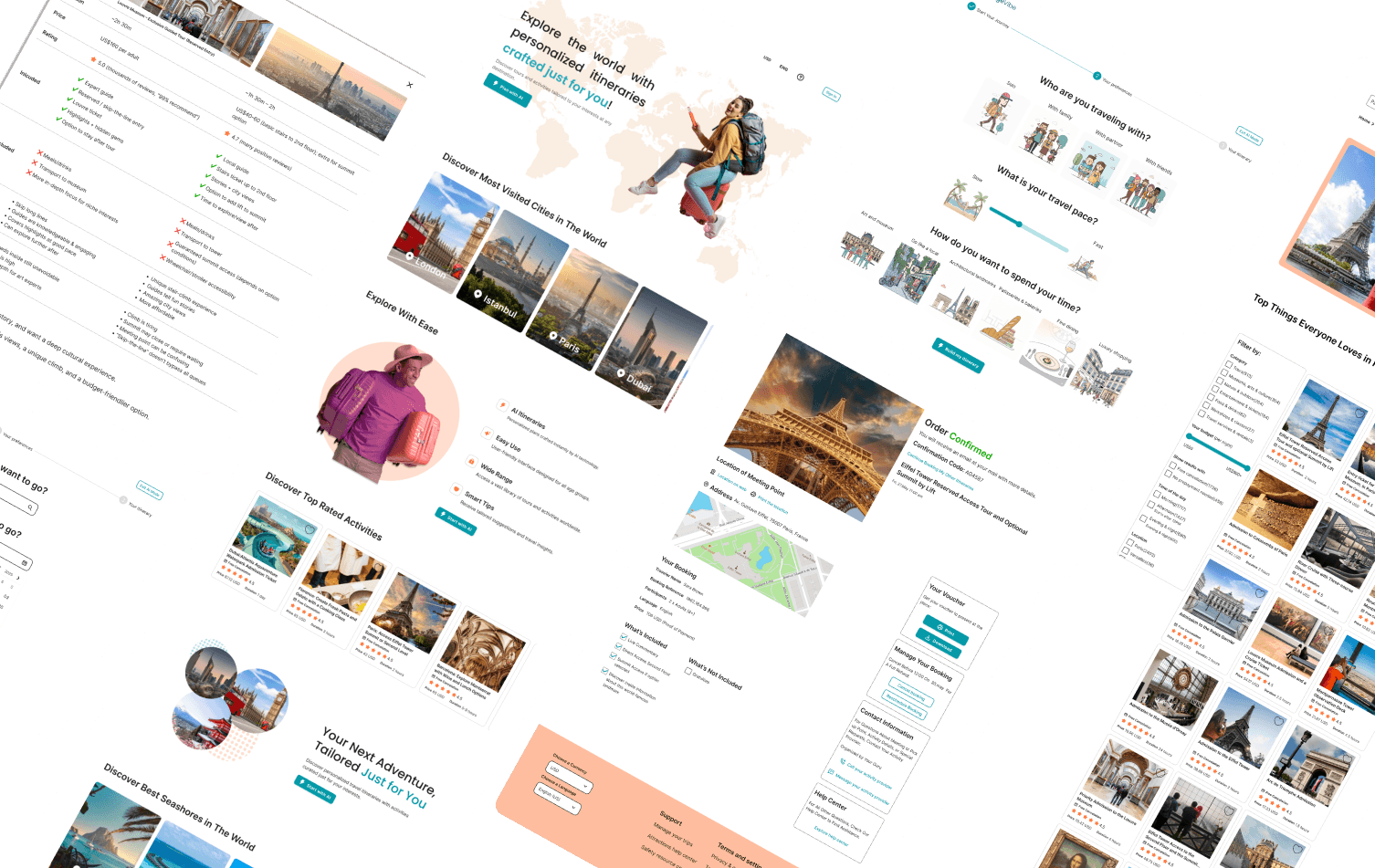
Stuck in Italy with no plan and decision fatigue setting in, I turned my own frustration into a research-led concept — interviews, surveys, competitor analysis, and usability testing.
CHALLENGE
How might we use AI to cut through travel decision fatigue — without making users feel like the app is deciding for them?
Evaluated users across low to high digital skill levels
6 user interviews + survey of 10
Designed to address the gaps and solve the user needs.
1
2
3
4
5
RESEARCH
Interviews + survey
SYNTHESIZE
Patterns + gaps
DEFINE
3 design goals
DESIGN
Lo-fi → Hi-fi
TEST
3-4 users, iterate
The idea came from a real moment: a week in Italy with no itinerary, no time to plan, and an overwhelming number of apps that showed me everything except what I actually wanted.
I started with 6 in-depth interviews with friends who travel 2–3 times a year — not to confirm my assumptions, but to challenge them. Then I ran a 10-person Google Forms survey to validate patterns at scale.
What I found: 60% of travelers feel overwhelmed by choice, not lack of options. 60% cited trust issues with review reliability. Only 40% wanted more personalization — but that 40% were the highest-intent users.
30+ minutes
15-30 minutes
5-15 minutes
5 minutes
50%
30%
15%
5%
40% Personalized recommendations
25 %Interactive maps
15% Integration with transportation
10% Integration with social media
5% Language translation
I also ran a competitive analysis across TripAdvisor, GetYourGuide, and Booking.com — not just looking at features, but reading user reviews to find where real frustration lived.

Personalization & itinerary tools inconsistent or underdeveloped
1.
2.
3.
My research showed users wanted personalization — but also wanted to feel in control. Full automation felt like losing agency. Full manual control defeated the point of AI.
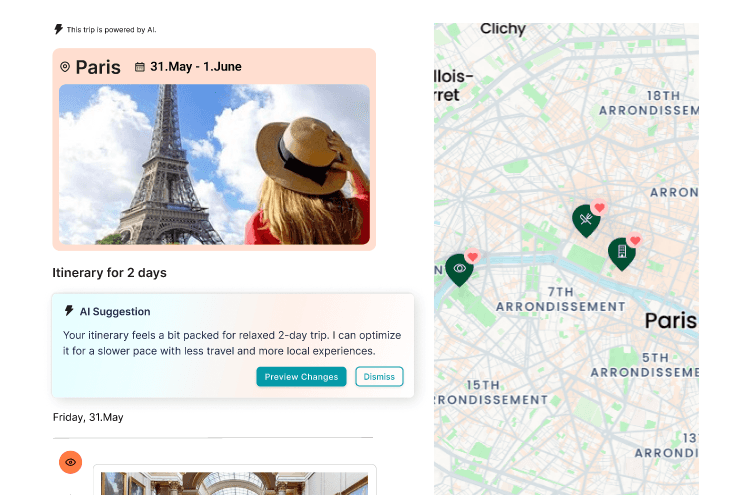
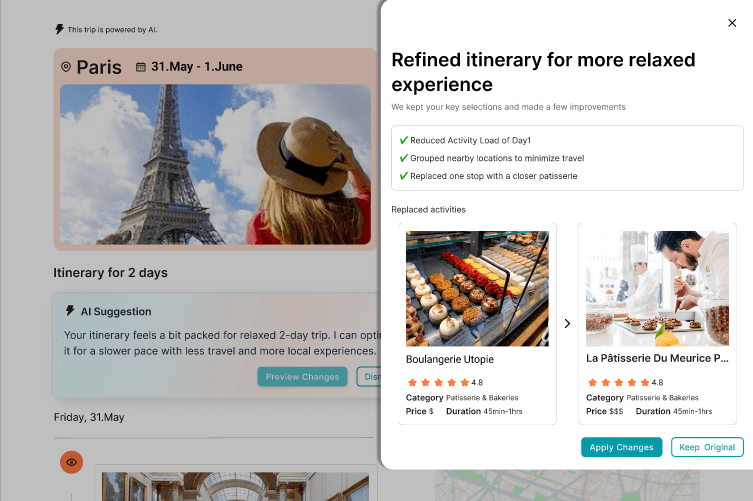
The resolution: AI proposes, user approves. Every AI suggestion is previewed before applying. Users see what changes and why. They can accept, reject, or adjust — the AI never acts unilaterally.
This tension — autonomy vs. automation — shaped every feature in the product.
Tradeoff: more steps in the flow, but significantly higher trust
Research showed 40% of users wanted personalization — but long setup forms kill momentum before value is felt. Three visual questions replace a traditional form. The app learns your pace, budget, and interests before you ever see a single result.
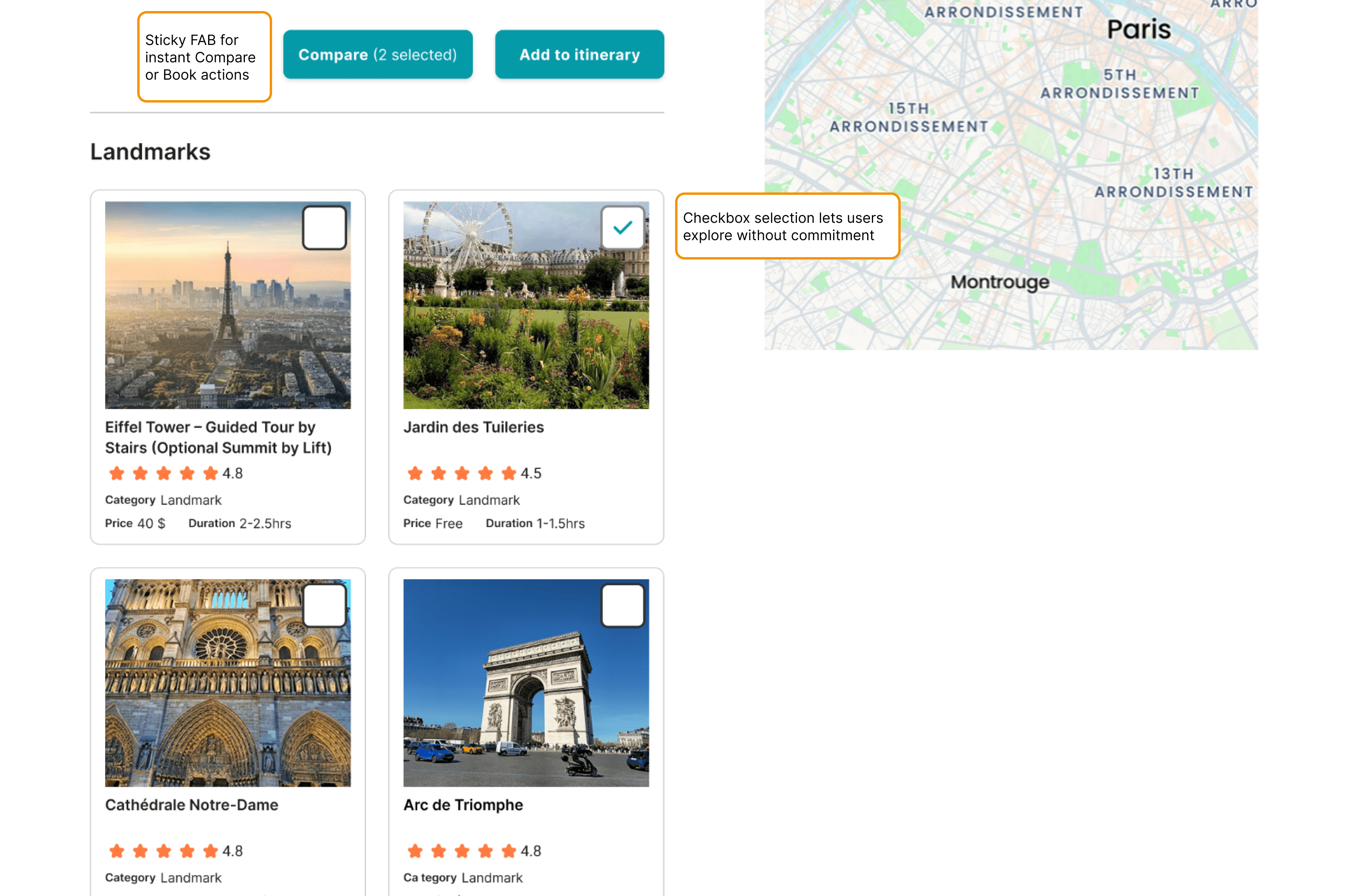
Users were mentally building spreadsheets to compare options — then abandoning the process entirely. I replaced that with a two-tap comparison: select, compare side-by-side, read AI-summarized pros and cons. Confident booking without the research spiral.
The hardest tension in this project: full AI automation felt like losing agency, but full manual control defeated the point. The resolution - AI proposes, user previews, user approves. The AI never acts unilaterally. Trust is built one transparent suggestion at a time.
Usability testing revealed that less tech-savvy users hit a wall before discovering the comparison feature. Instead of a help section, I added two contextual tooltips at exactly the moments of likely confusion - guidance that disappears once it's no longer needed.
Competitors surface landmarks and leave research to the user. I asked: what if the app had already done that work? One best-fit recommendation - matched to your profile, explained, and bookable in one tap. Alternatives stay accessible but don't compete for attention.
60% of users in my research cited trust as their primary barrier. Asking for an account before showing value compounds that distrust. Build a full itinerary first. Sign up only when there's something worth saving. Registration as a reward, not a gate.
I tested the prototype with 3–4 users. The most important thing I learned had nothing to do with UI.
One friend — a frequent app user — completed every scenario with almost no guidance. Another, less familiar with similar products, struggled to understand the flow from the start. Same design, completely different experience.
This revealed a real segmentation gap: the product assumed a baseline of digital fluency that not all target users share. For V2, onboarding needs two tracks — an express path for confident users and a guided path for first-timers.
The "AI suggests, you approve" pattern tested well — users felt in control even when AI was doing most of the work. The preview-before-apply mechanic was the key trust signal.